 Lattice
Messaging for the day the internet doesn't work.
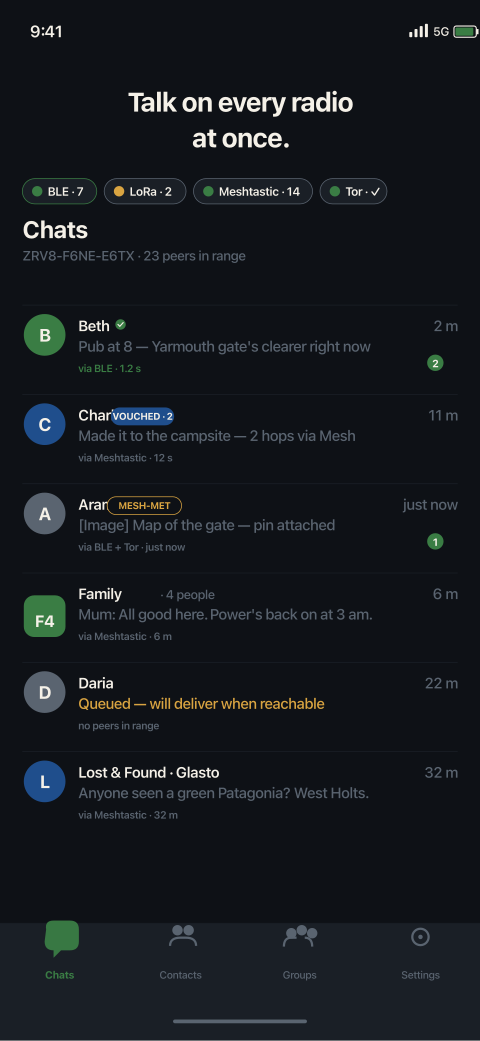
Most days the internet works and you won't need this. But some days it doesn't. The towers jam solid at a festival, a storm takes out the grid, a government decides to switch the network off for a while. Lattice keeps going on those days, because it sends messages straight from one phone to the next over Bluetooth and Wi-Fi, with nothing in the middle. Set it up now, add the few people you'd really need to reach, and forget about it until you do.
Get Lattice.
It's free, and it stays free because a few people chip in, not because anyone's selling ads or your data. There's nothing to buy once you're in.
Android — direct download
You can install the Lattice APK straight onto an Android phone, no Play Store and no Google in the loop.
Open the link on your phone, tap the file, and if it asks, let your browser install apps from outside the store. Some newer Android versions want a reboot afterwards. The APK is signed with the Lattice release key; the SHA-256 fingerprint is below, and it's worth checking before you install.
SHA-256: published with each release at /downloads/lattice-android.apk.sha256
A Play Store listing is on the way too, if you'd rather wait for that.
iPhone
The iPhone build is on TestFlight now, and the App Store listing is in the works (we've just sent the first build to Apple). Apple won't let apps install themselves outside the App Store, so on iPhone it's TestFlight for the moment and the App Store soon. It's iPhone-only for the first version; the iPad layout comes later.
If you want in on the beta, say hello in the Matrix room and ask for a TestFlight invite.
Want to chip in? One person builds and looks after Lattice. If it's useful to you, buy me a coffee or send a little Bitcoin to bc1qcfdda2757yxrq9g2wh7trdny7sznycmvd4829y. One-off, no subscription, no strings.
Your phone is more than a camera and an internet device.
Two phones near each other can talk directly, over Bluetooth or Wi-Fi, without any tower or any company carrying the message. That's not new and it's not a trick; it's just a part of the radio hardware that almost nothing uses. Lattice uses it. Think of how a CB radio reaches the radios near it, or how a sat phone still works when the masts are dead.
You'll carry on with whatever messenger you already use for everyday chat. Lattice waits in the background, barely touching the battery, until the day the usual stuff stops working.
A few things worth knowing.
It works when the towers don't.
Internet shutdowns, regional outages, a festival field where every mast is maxed out, the days after an earthquake or a hurricane. In all of those, Lattice still moves a message between phones in the same area, hopping it through other people running Lattice until it reaches whoever you sent it to.
Nobody in the middle can read it.
Everything is end-to-end encrypted, with post-quantum cryptography on top. A phone passing your message along only ever sees a sealed envelope it has no way to open. There's no Lattice server holding your conversations because there's no server at all. The only copies live on your phone and on the phones of the people you wrote to.
It's only as good as the people you've added.
Lattice is for reaching people you actually know: family, close friends, the people you'd want to find in a mess. The time to set it up is before you need it, while you've got signal and a quiet minute. Once a month it'll nudge you to send a test message so you know the line's still open.
Long-range radio is built in.
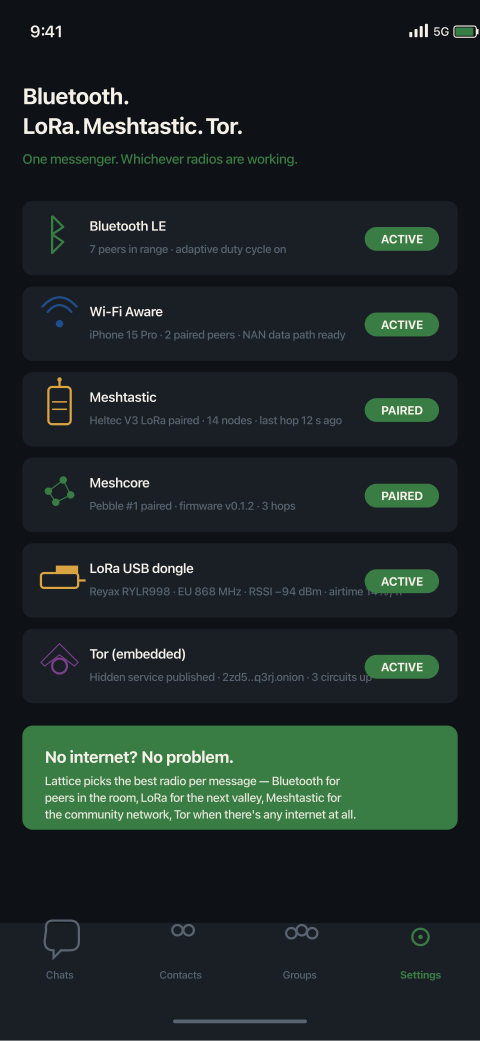
Lattice already speaks LoRa and can ride the Meshtastic network, both inside the app. We've watched a Lattice handshake cross a real LoRa hop between two Meshtastic boards. That stretches it from a hundred-metre Bluetooth reach to something that can cross a town with no cell network at all. On Android you plug in a £20–40 USB-C LoRa stick; on iPhone you pair a Meshtastic device over Bluetooth, because iOS won't let an app talk to USB serial. The long-range side is still being shaken out on real hardware, and the USB dongles aren't all behaving yet. Which devices, and how it works.
Run your own relay.
Got an old phone in a drawer? Put Lattice Node on it, leave it on the charger, and it quietly relays for every Lattice user nearby. Or flash the open Lattice Pebble firmware onto a £15 ESP32 board and screw it to a fence post. Free, no maker to buy from, nothing to register. The network gets bigger every time someone does this.
What it doesn't do.
This isn't a replacement for Signal or WhatsApp. They're faster, they do more, and they can reach anyone on earth as long as the internet's up. Keep using them. Lattice is the thing you fall back on the day they go quiet.
It also can't beat physics. Two phones in different cities can't reach each other through Lattice unless someone carries the message between them, or the network comes back, or there's a LoRa link in the chain. The full list of what it can't do is on its own page: where Lattice stops.
For the curious.
- How it works — the plain-language version, with diagrams.
- Use cases — five situations where you'd actually reach for it.
- vs. — how it stacks up against WhatsApp, Signal, Bitchat and Briar.
- White papers — the threat model, the invite scheme, the dormancy design, and where it stops.
- The source goes public under the MPL 2.0 when v1.0 lands. Until then, the binary is what you can inspect.
- Lattice on Matrix — ask questions, follow along, or grab a TestFlight invite.