 Lattice
Press kit.
For journalists, writers, and researchers covering Lattice. Plain-language description, logo files, app screenshots, contact.
One paragraph.
Lattice is an offline-first, end-to-end encrypted, peer-to-peer messenger for the day the internet doesn't work. It moves messages between phones over Bluetooth and Wi-Fi Aware, with LoRa, Meshtastic and an optional Tor bridge built in to extend the reach, and no servers, accounts or phone numbers anywhere. Your identity is a 12-word phrase that lives only on your phone. The mesh is built to scale to festival-density crowds and to cost almost nothing in battery between uses, so most people install it once and let it sit until they need it. Built by one independent developer. Source opens under the Mozilla Public License 2.0 at v1.0.
Two paragraphs.
Lattice is an offline-first, end-to-end encrypted messenger for the moments when the cellular network and the internet aren't there: government shutdowns, festival crowds, regional outages, disasters. It uses the radios already in every modern phone, Bluetooth and Wi-Fi Aware, to pass messages between phones directly, hopping through other Lattice users in between when the recipient isn't in range. LoRa, Meshtastic and an optional Tor bridge are built in to stretch that reach further. There's no Lattice company server in the middle, no account to create, no phone number to provide. Your identity is a 12-word seed phrase generated on your phone, kept hardware-protected by the Secure Enclave on iOS or StrongBox on Android, and never sent anywhere.
The cryptography is hybrid post-quantum. Every session uses both Curve25519 (the same primitive as Signal and WhatsApp) and ML-KEM-768 (the NIST FIPS 203 post-quantum standard), so even an adversary who later breaks one of them can't go back and read your traffic. Groups use MLS (RFC 9420). The stack opens under MPL 2.0 at v1.0, and the project commits to reproducible Android builds, signed-source attestation for iOS, full publication of audit reports, and a coordinated security disclosure policy. Lattice is a companion to Signal rather than a substitute for it. Most days you'll keep using whatever messenger you already have, and Lattice waits in the background for the day it stops working.
Quick facts.
- Founded: 2026, by an independent developer (named publicly at v1.0)
- License: MPL 2.0 at v1.0 (file-level copyleft); source private until then
- Repository: published with v1.0 release
- Cryptography: hybrid Curve25519 + ML-KEM-768, ChaCha20-Poly1305, MLS for groups
- Platforms: iOS 17+, Android 10+ (Wi-Fi Aware on iOS 26+, Android 12+)
- Availability: Android: signed APK installable now, Play listing in progress. iPhone: in TestFlight beta now, App Store listing in progress (iPhone-only for v1).
- Cost: free, donation-supported, no ads / subscriptions / data sales
- Telemetry: none, ever
- Servers: none
- Data we collect: none
- Privacy nutrition label: Data Not Collected across every category
Logo.
The Lattice mark is a speech bubble silhouette built from a mesh of dots, clustering more densely toward the lower-left corner where the tail reads. It pairs deep ink (#0E1116) on bone (#F5F1E8). Use the SVG wherever you can.
- SVG (vector master)
- PNG · 1024 px — store-listing master
- PNG · 512 px
- PNG · 256 px
- PNG · 128 px


Screenshots.
Eight stills from the iOS app. Identical compositions exist for iPad and Android — drop a note in our Matrix room if you need a specific platform or a full-resolution App Store render (1290×2796).
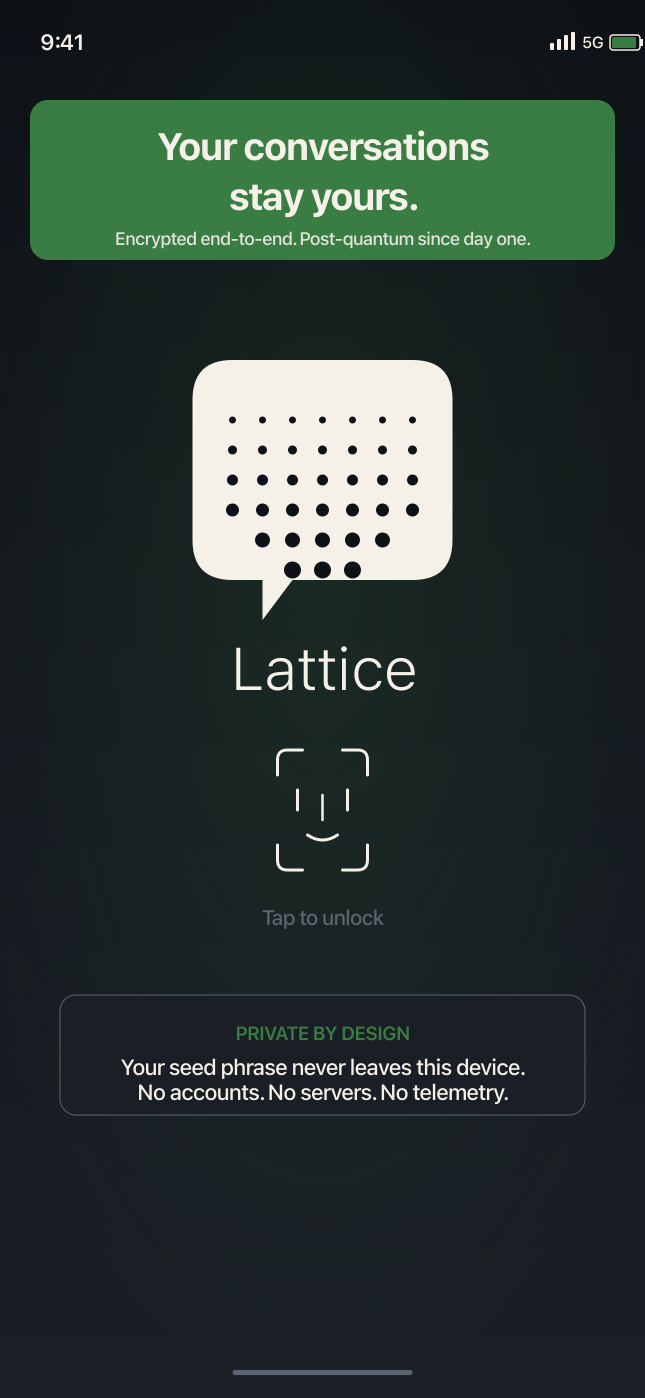
- 01 — Lock screen, biometric unlock
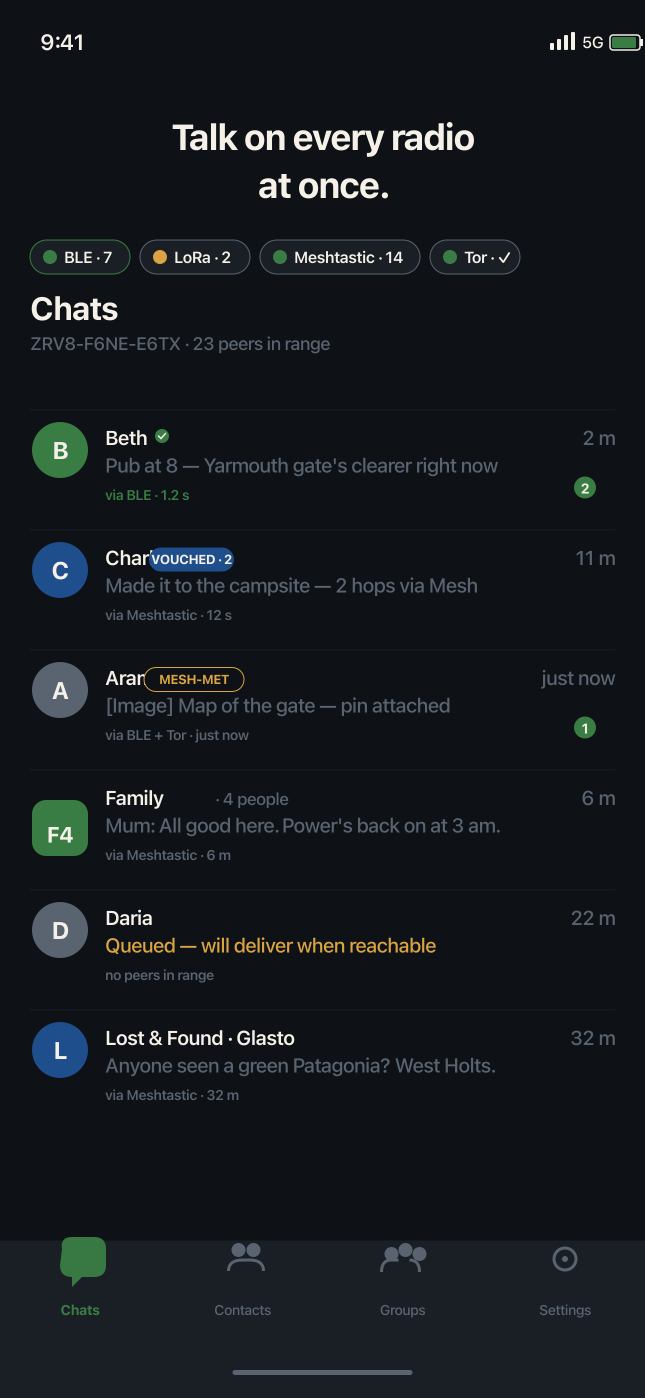
- 02 — Chats list, bearer chips
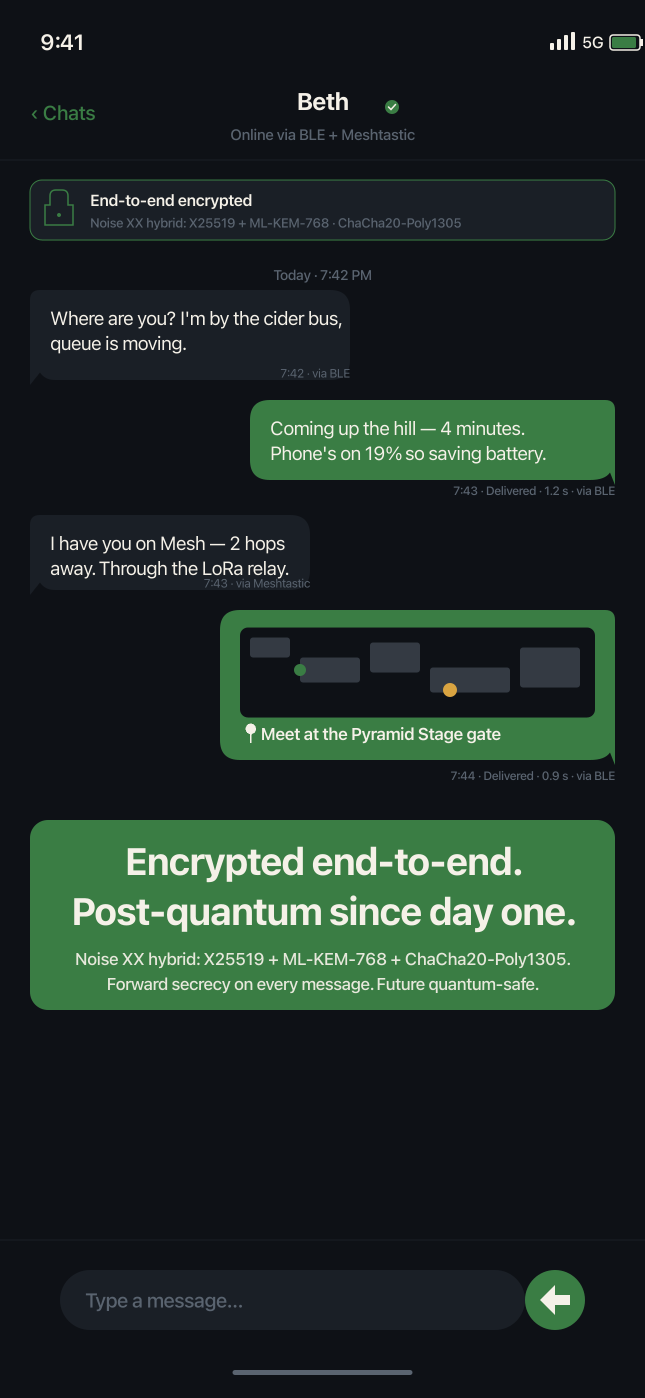
- 03 — Chat detail with the post-quantum crypto strip
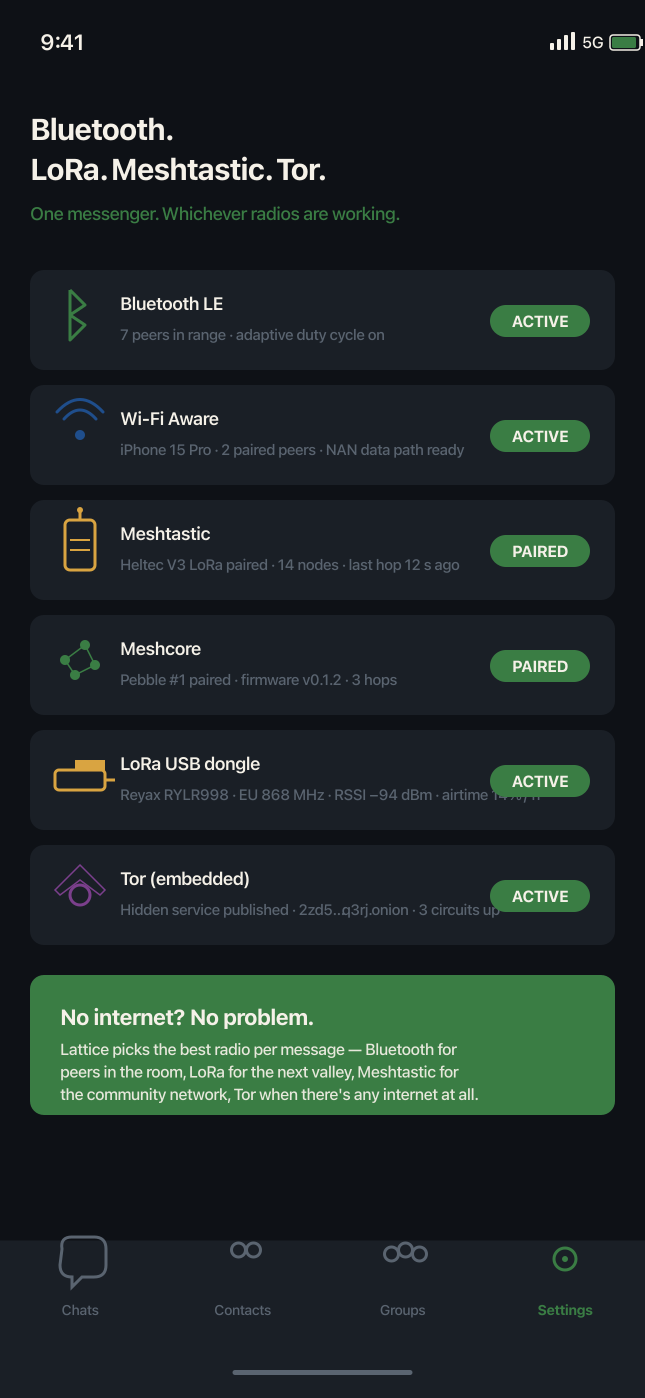
- 04 — Connected hardware: Bluetooth, Wi-Fi Aware, Meshtastic, LoRa, Tor
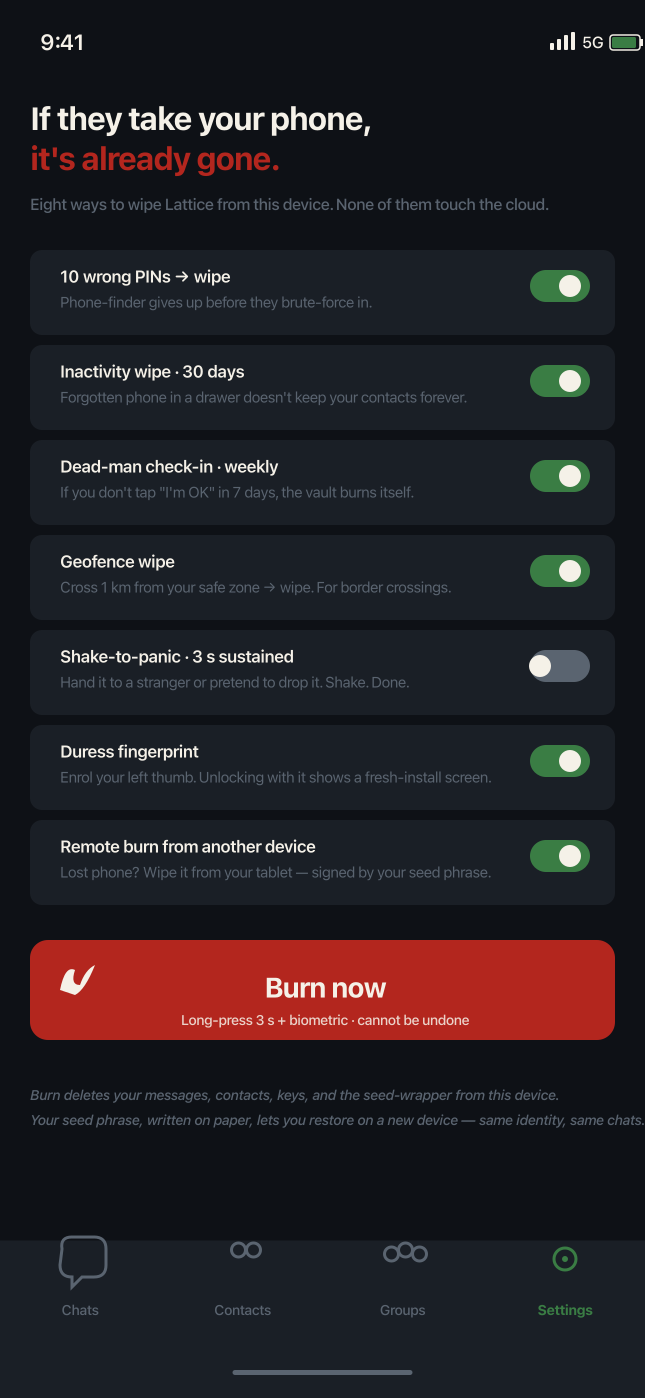
- 05 — Burn arsenal (anti-coercion settings)
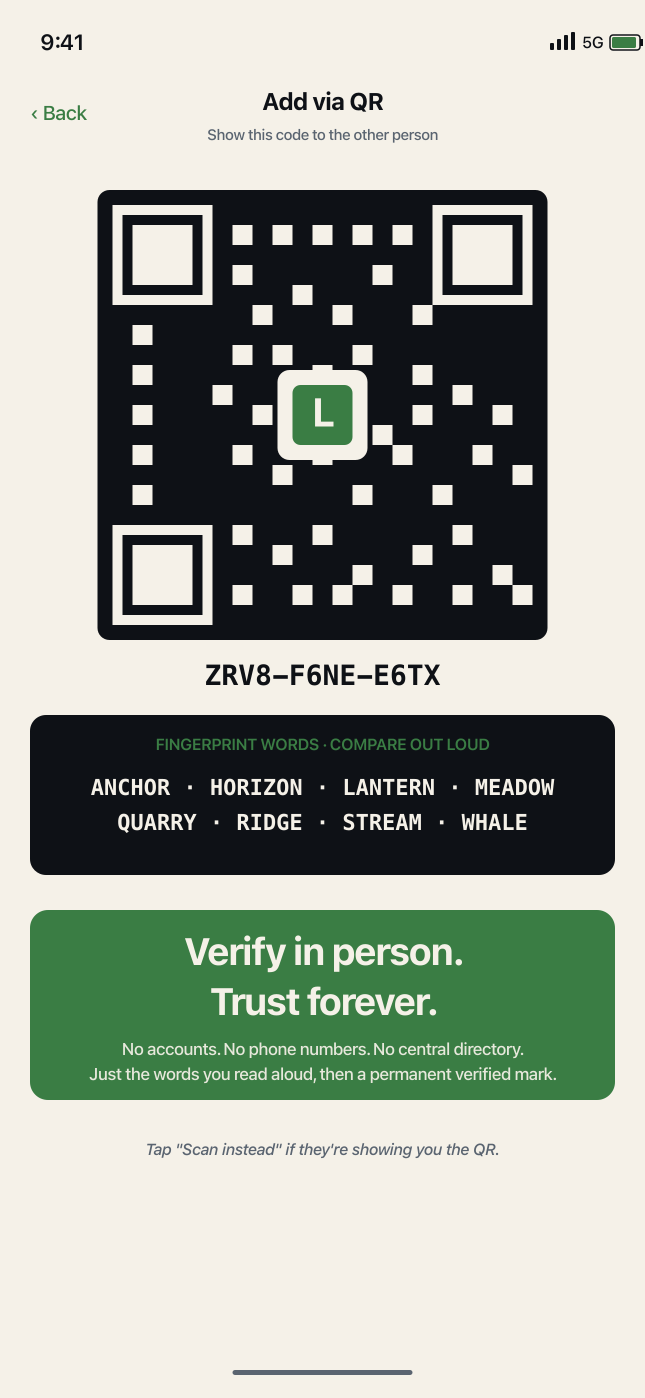
- 06 — QR contact verification with fingerprint words
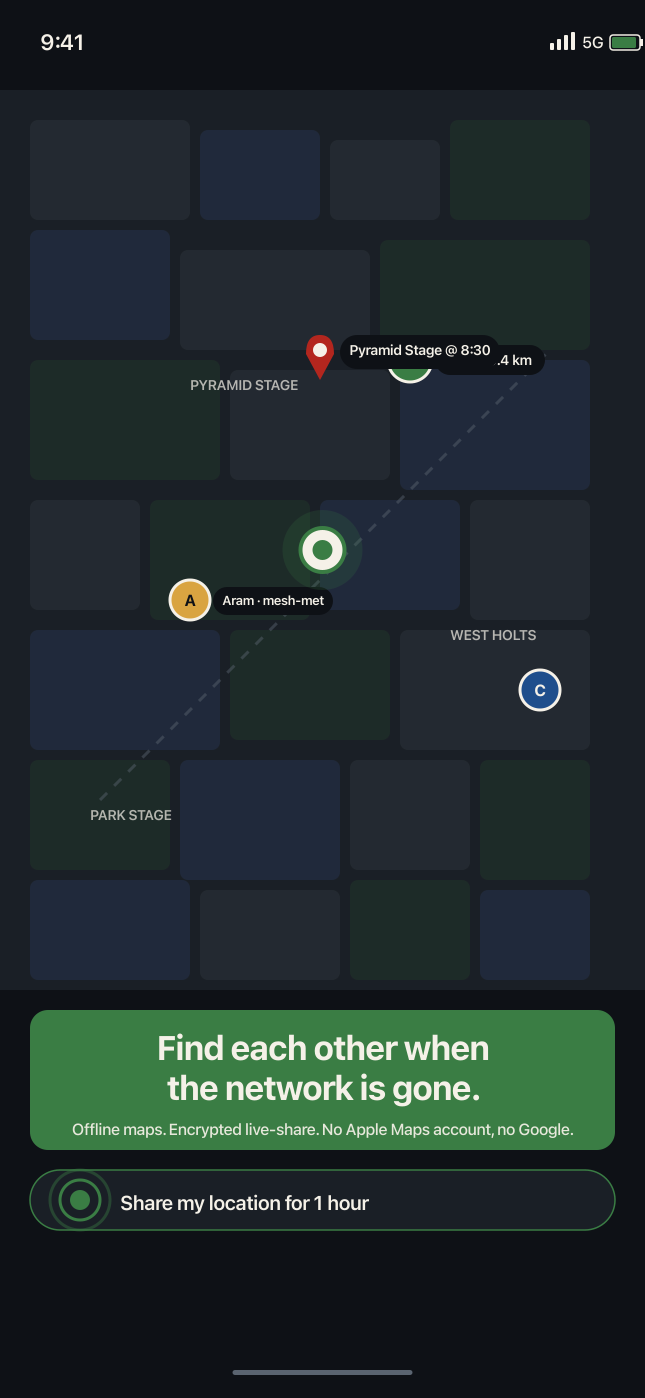
- 07 — Offline map with live-share
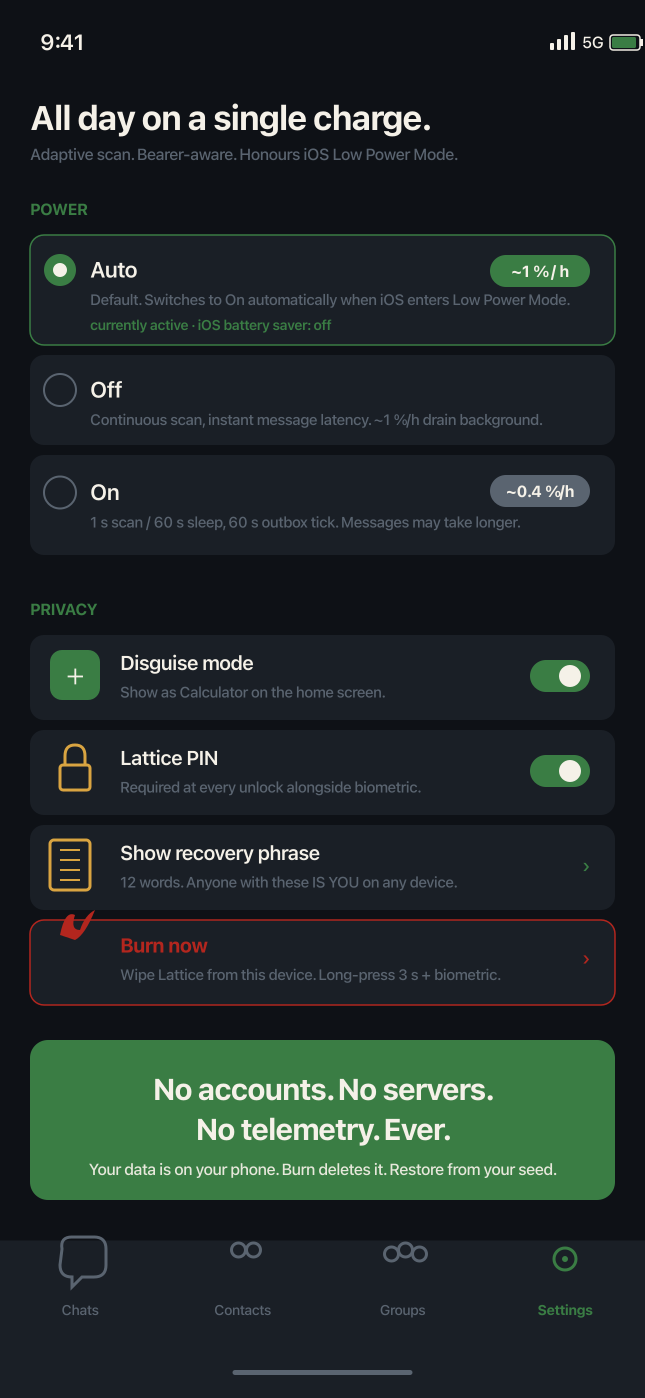
- 08 — Power profiles + privacy posture
Founder's letter.
If you want the why-this-exists in the words of the person who built it: /letter. Personal, short, no marketing language.
Plain words about Lattice.
If you're writing about Lattice, I'd rather you wrote something accurate than something flattering. A few things worth knowing:
- Lattice is a small project. There's no Series-B-funded startup behind it.
- It doesn't work everywhere. It depends on how many people nearby are running it, and it's range-limited.
- Its iOS background-notification reliability is bounded by Apple's platform constraints. The realistic numbers are documented: 40–60% reliability when the phone has been locked overnight.
- Its battery cost is real. Lower than Briar, higher than WhatsApp.
- Most days Signal is the better choice. Lattice is for the situations where Signal isn't available.
Things we won't do.
- Press releases for routine releases.
- "Lattice partners with..." announcements.
- Influencer marketing.
- Affiliate links.
- Sponsored content.
- Hyperbole. "Revolutionary." "Game-changing." "Next-generation." Any title-case marketing phrase.
Contact.
Press / journalist enquiries: our Matrix room
General: our Matrix room
Security: our Matrix room (PGP key linked from /security-disclosure)